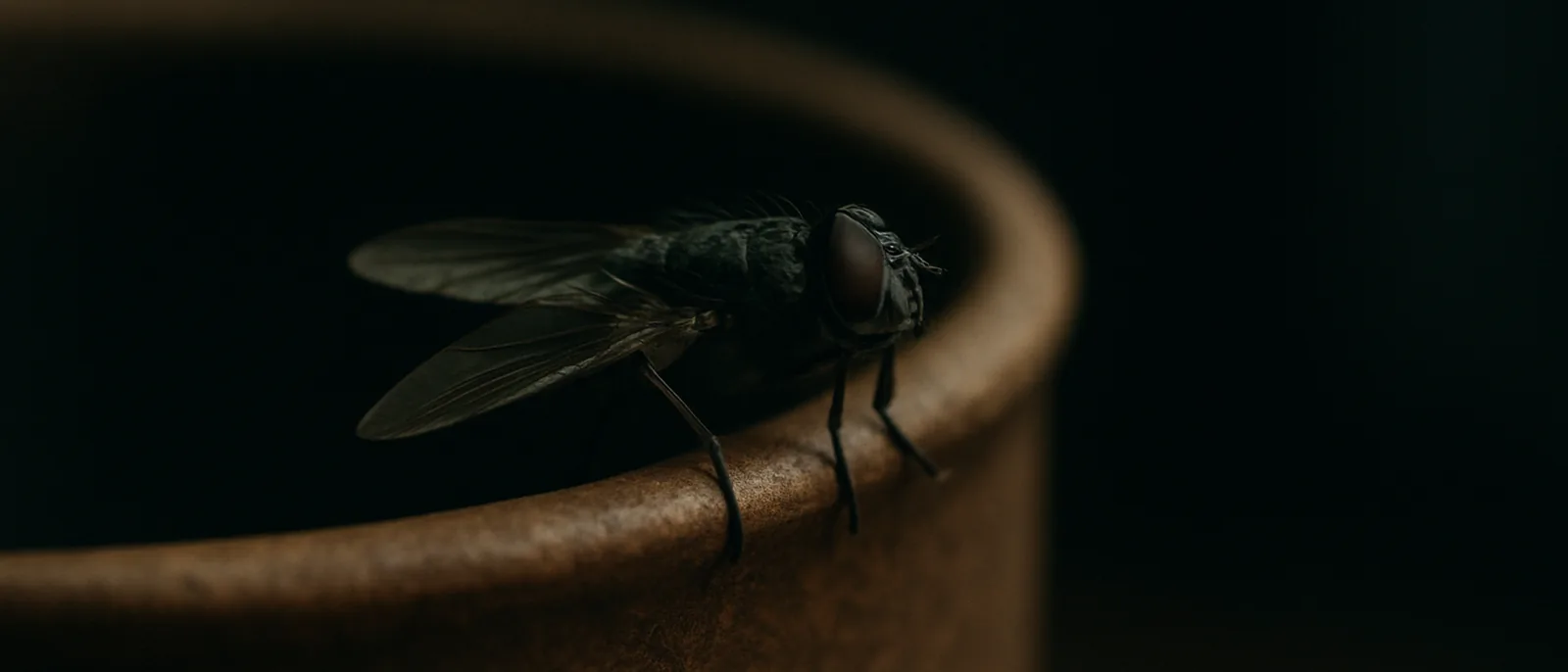
This entry examines a widely circulated hadith instructing that a fly which falls into a drink should be fully dipped before being removed, on the stated ground that one of its wings carries a disease and the other its cure. It is among the most contested items in this collection: the narration is authentic, but the modern scientific claim built on it is not.
The source text
إِذَا وَقَعَ الذُّبَابُ فِي شَرَابِ أَحَدِكُمْ فَلْيَغْمِسْهُ ثُمَّ لِيَنْزِعْهُ فَإِنَّ فِي إِحْدَى جَنَاحَيْهِ دَاءً وَالأُخْرَى شِفَاءً
“If a housefly falls in the drink of anyone of you, he should dip it (in the drink) and take it out, for one of its wings has a disease and the other has the cure for the disease.”
Sahih al-Bukhari 3320 · Grading: sahih (al-Bukhari (by inclusion))
إِذَا وَقَعَ الذُّبَابُ فِي إِنَاءِ أَحَدِكُمْ فَامْقُلُوهُ فَإِنَّ فِي أَحَدِ جَنَاحَيْهِ دَاءً وَفِي الآخَرِ شِفَاءً
“When a fly alights in anyone's vessel, he should plunge it all in, for in one of its wings there is a disease, and in the other is a cure.”
Sunan Abi Dawud 3844 · Grading: sahih (al-Albani)
What was understood in the seventh century
In seventh-century Arabia, as everywhere in the pre-modern world, the fly was regarded as a pest linked to decay and filth. There existed no concept of microorganisms, no germ theory of disease, and no notion of antibiosis — the phenomenon by which one organism produces a substance that suppresses another. The report is therefore doing two things at once: giving a practical instruction, and attaching to it a claim that the insect's two wings carry opposing properties.
The Prophet Muhammad (peace be upon him) is reported to have given this instruction in narrations preserved by al-Bukhari and by Abu Dawud, the latter graded sahih by al-Albani. On the level of transmission, the hadith is authentic. Classical commentators such as al-Khattabi and Ibn al-Qayyim treated it as sound and read it as advice rather than a binding command.
The modern correspondence
Some modern writers argue that the report anticipated a real biological pattern: that the housefly carries both harmful microbes and agents that counteract them. It is true that insects, including flies, can host bacteriophages (viruses that kill bacteria) and microbes that produce antibacterial compounds, and a small 2020 study reported antibacterial activity associated with the fly's right wing.
The correspondence claimed here, however, is weak. The study in question is small, appeared in a low-impact venue, and has not been independently replicated; it falls well short of establishing that a fly's wing reliably delivers a 'cure' for whatever pathogens the other wing carries. Mainstream public-health science reaches the opposite practical conclusion.
Considerations and counterpoints
The case here is weak, and this site rates it accordingly. Public-health authorities classify the housefly as a mechanical vector of disease: its legs, body, and both wings can carry bacteria such as E. coli, Salmonella, and Shigella, and standard guidance is to keep flies away from food, not to submerge them in it. The studies advanced in support of the hadith are few, methodologically limited, and not accepted as demonstrating any general antimicrobial effect.
Critics reasonably read the report as reflecting the folk medicine of its time. Defenders respond that the instruction was treated by classical scholars as advisory, and that absence of confirming laboratory evidence is not the same as disproof. The honest position for a reference work is the one taken here: the narration is authentic, but the popular 'science has confirmed it' claim is not supported by the current state of microbiology, and readers should not treat it as established fact.
Credibility rating: Tier 3 · Contested — The narration is authentic, but the claim that fly wings reliably carry a 'cure' is not established science; mainstream microbiology treats flies as contamination vectors and the supporting studies are few and weak.