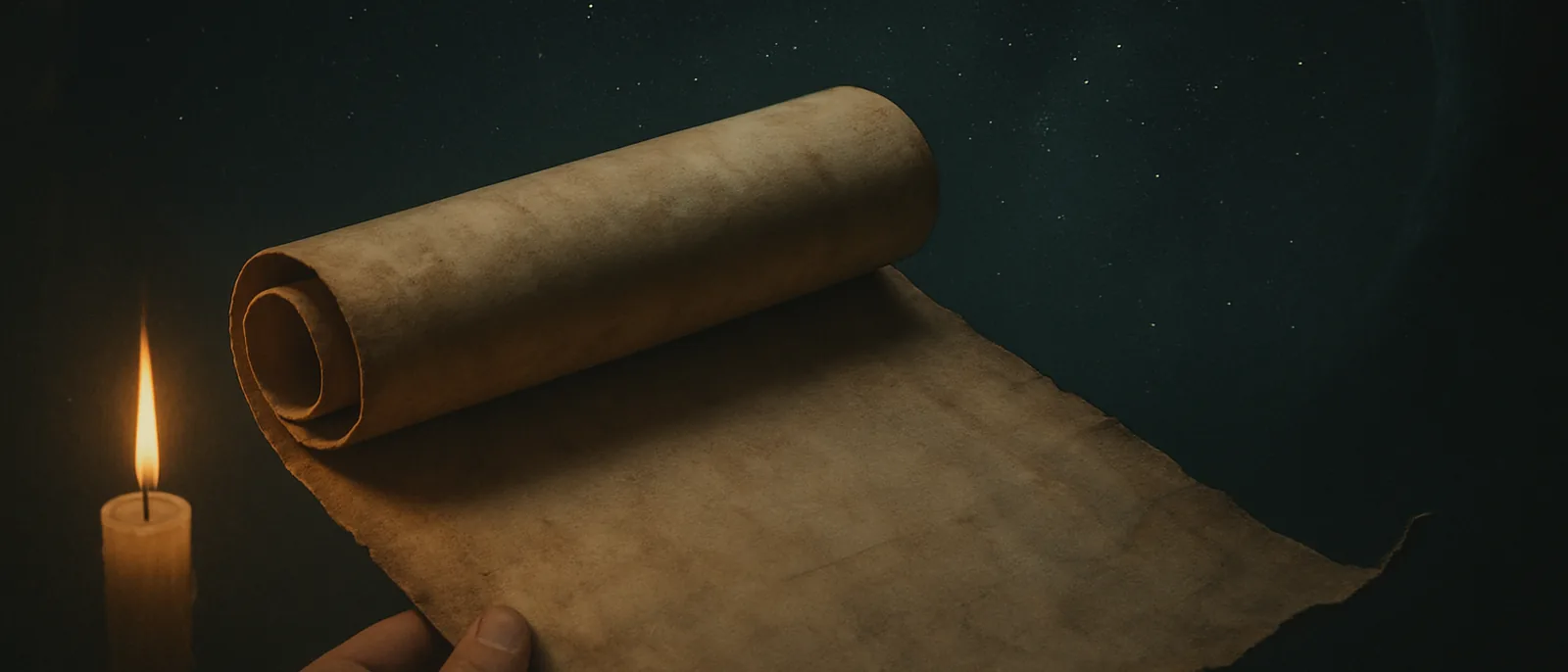
This entry considers two verses that picture the sky being folded or rolled up at the end of the world, and the modern reading that connects them to the possible end-state of the universe. The image is striking, but the scientific parallel is interpretive and, on current evidence, runs against the favored model.
The source text
يَوْمَ نَطْوِى ٱلسَّمَآءَ كَطَىِّ ٱلسِّجِلِّ لِلْكُتُبِ ۚ كَمَا بَدَأْنَآ أَوَّلَ خَلْقٍ نُّعِيدُهُۥ ۚ وَعْدًا عَلَيْنَآ ۚ إِنَّا كُنَّا فَـٰعِلِينَ
“The Day when We will fold the heaven like the folding of a [written] sheet for the records. As We began the first creation, We will repeat it. That is a promise binding upon Us. Indeed, We will do it.”
Qur'an 21:104 · Saheeh International
وَمَا قَدَرُوا۟ ٱللَّهَ حَقَّ قَدْرِهِۦ وَٱلْأَرْضُ جَمِيعًا قَبْضَتُهُۥ يَوْمَ ٱلْقِيَـٰمَةِ وَٱلسَّمَـٰوَٰتُ مَطْوِيَّـٰتٌۢ بِيَمِينِهِۦ
“They have not appraised Allah with true appraisal, while the earth entirely will be [within] His grip on the Day of Resurrection, and the heavens will be folded in His right hand.”
Qur'an 39:67 · Saheeh International
What was understood in the seventh century
The Qur'an speaks repeatedly of a definite close to the present cosmic order. Two passages give the same vivid picture. In Surah al-Anbiya the heaven is folded 'like the folding of a [written] sheet for the records' — the motion of rolling up a scroll to be filed away — and the verse adds, 'As We began the first creation, We will repeat it.' In Surah az-Zumar the heavens are described as 'folded in His right hand' on the Day of Resurrection.
To a seventh-century audience the meaning was plain and theological: the created heavens, like a document, had a beginning and would be wound up at an appointed end by the One who made them. The image belongs to the Qur'an's eschatology — its account of the Last Day — and classical commentators read it in that register, as a statement of divine power over creation's beginning and end.
The modern correspondence
Modern cosmology agrees on two points that these verses assert: the universe had a beginning, and it will have an end-state. What that end-state will be, however, remains an open question. One long-discussed possibility is the 'Big Crunch,' in which the expansion of the universe eventually halts and reverses, so that everything contracts back toward a single dense point — in some versions, only to begin again in a new cycle.
Some commentators connect the folding-scroll image, and especially the clause 'As We began the first creation, We will repeat it,' to such a contracting or cyclic cosmos: a universe that is rolled back up toward its origin and renewed. On this reading the verse is taken to anticipate not merely that the world ends, but that it ends by folding back on itself.
Considerations and counterpoints
The case here is weak, and the entry is rated accordingly. On their plain sense the verses are about the Day of Resurrection and God's winding-up of the created order, not a physical model of cosmic contraction; that is how the classical exegetes understood them.
The scientific parallel is also weaker than it first looks. The 'Big Crunch' is only one candidate for the universe's fate, and it is not the one the evidence currently favors. Since 1998, observations of distant supernovae have shown that cosmic expansion is accelerating, driven by what is called dark energy, which points toward an ever-expanding, ever-cooling 'Big Freeze' rather than a contraction. A reader may find the image of a folded scroll evocative of a cosmos that ends, or even of a cyclic universe, but the correspondence is interpretive and does not track the present scientific consensus. Critics of the broader 'scientific miracle' genre, such as Ziauddin Sardar and Nidhal Guessoum, caution that matching an ambiguous poetic image to a contested physical theory is exactly the kind of after-the-fact fitting a careful reader should resist.
Credibility rating: Tier 3 · Contested — The passages are clearly about the end of the world in an eschatological sense; the 'Big Crunch' reading is one interpretation among several, and current evidence actually favors continued, accelerating expansion rather than a contraction.