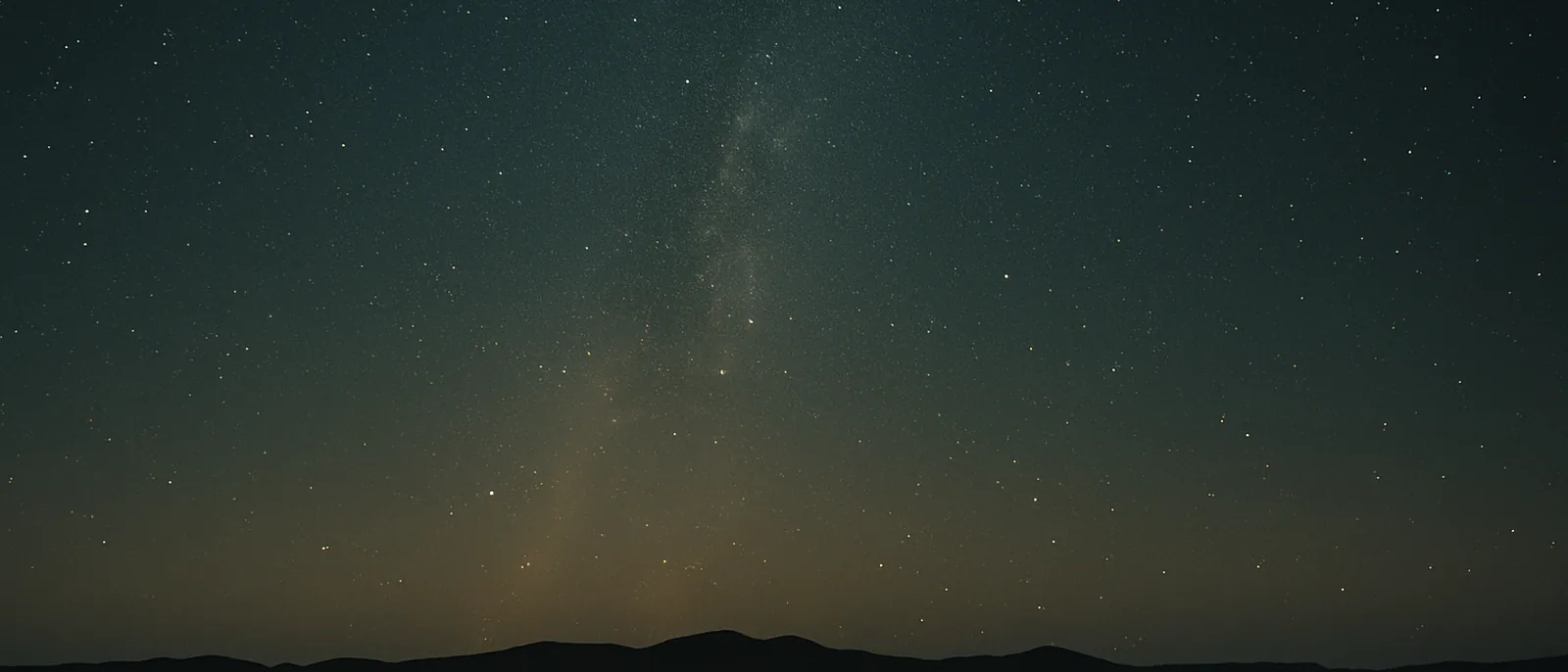
This entry examines the oath of Surah al-Waqi'ah 56:75–76 — sworn by the mawaqi' of the stars and called “an oath, if you could know, [most] great” — and the modern suggestion that stellar positions conceal a magnitude the seventh century could not have grasped. The case here is frankly speculative, and this entry is rated accordingly.
The source text
فَلَآ أُقْسِمُ بِمَوَٰقِعِ ٱلنُّجُومِ
“Then I swear by the setting of the stars,”
Qur'an 56:75 · Saheeh International
وَإِنَّهُۥ لَقَسَمٌ لَّوْ تَعْلَمُونَ عَظِيمٌ
“And indeed, it is an oath - if you could know - [most] great.”
Qur'an 56:76 · Saheeh International
What was understood in the seventh century
Pre-Islamic Arabs were accomplished naked-eye observers who used star risings and settings — the anwa' system — for navigation and seasonal reckoning, so swearing by the stars was culturally intelligible to the first audience of the Prophet Muhammad (peace be upon him). Stars were assumed to be small lights fixed to a nearby dome; their distances, physical scale, and the finite speed of light were entirely unknown, and no contemporary tradition treated stellar positions as exceeding human knowledge in any technical sense. The oath formula itself, with its emphatic parenthesis, is what modern readers seize upon.
The modern correspondence
Modern astronomy shows that stellar “positions” are stranger than they appear. Stars lie at distances of light-years — the nearest beyond the sun is about 4.2 light-years away — so each star is seen where and as it was years to millennia ago; apparent places are further shifted by proper motion, parallax, and aberration, and mapping true positions is the work of dedicated space missions such as ESA's Gaia, launched in 2013. NASA's explanation of the light-year conveys the scales involved.
Commentators have suggested that the parenthetical “if you could know” hints that the oath's object holds a magnitude beyond seventh-century comprehension, and that the light-year scale of stellar positions vindicates the hint. It should be said plainly that this is an evocative reading, not a stated correspondence: the verse asserts no measurable fact about distance or light.
Considerations and counterpoints
Classical commentators read mawaqi' an-nujum as the setting-places of the stars, or as the piecemeal descent of the Qur'an itself — readings with nothing to do with stellar distances. Critics note that “a mighty oath if you only knew” is standard oath rhetoric emphasizing solemnity, found across the Qur'an's oath formulas, and that reading light-years into it is retrofitting. Translation variance matters here too: Saheeh International renders the word as “setting,” while the “positions” wording quoted in many miracle presentations follows other translators. Given all this, the entry stands mainly as an example of how far interpretive claims can stretch, and it should be weighed with that caution. Its inclusion reflects this site's policy of documenting commonly cited claims honestly rather than curating only the strongest.
Credibility rating: Tier 3 · Contested — The verse is authentic and the astronomy is sound, but connecting an unspecified 'mighty oath' to light-travel distances is speculative and finds no support in classical exegesis.