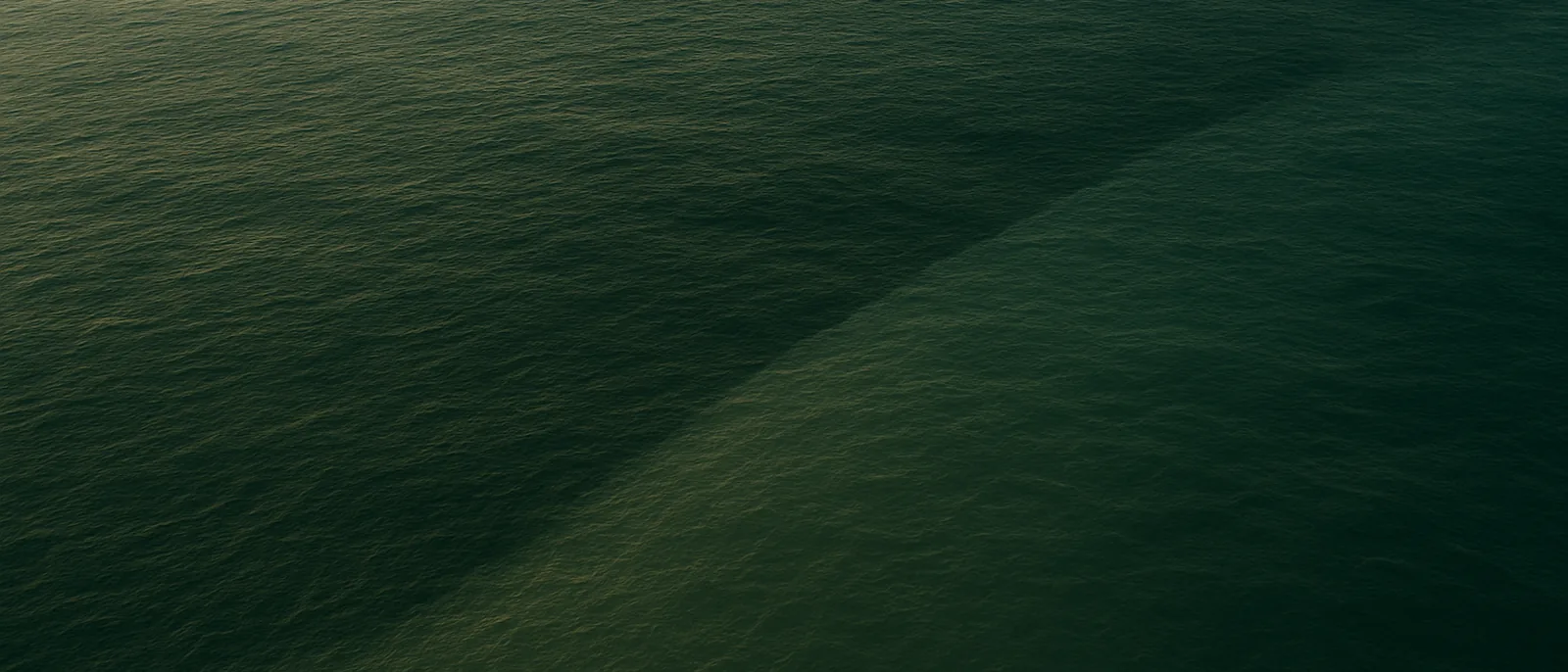
This entry examines the Qur'anic image of two seas that meet yet keep a partition, or barzakh, between them, expressed across three passages, and whether it corresponds to the way physical oceanography describes adjacent water masses that resist rapid mixing.
The source text
مَرَجَ ٱلْبَحْرَيْنِ يَلْتَقِيَانِ بَيْنَهُمَا بَرْزَخٌ لَّا يَبْغِيَانِ
“He released the two seas, meeting [one another]; Between them is a barrier [so] neither of them transgresses.”
Qur'an 55:19-20 · Saheeh International
۞ وَهُوَ ٱلَّذِى مَرَجَ ٱلْبَحْرَيْنِ هَـٰذَا عَذْبٌ فُرَاتٌ وَهَـٰذَا مِلْحٌ أُجَاجٌ وَجَعَلَ بَيْنَهُمَا بَرْزَخًا وَحِجْرًا مَّحْجُورًا
“And it is He who has released [simultaneously] the two seas [i.e., bodies of water], one fresh and sweet and one salty and bitter, and He placed between them a barrier and prohibiting partition.”
Qur'an 25:53 · Saheeh International
أَمَّن جَعَلَ ٱلْأَرْضَ قَرَارًا وَجَعَلَ خِلَـٰلَهَآ أَنْهَـٰرًا وَجَعَلَ لَهَا رَوَٰسِىَ وَجَعَلَ بَيْنَ ٱلْبَحْرَيْنِ حَاجِزًا ۗ أَءِلَـٰهٌ مَّعَ ٱللَّهِ ۚ بَلْ أَكْثَرُهُمْ لَا يَعْلَمُونَ
“Is He [not best] who made the earth a stable ground and placed within it rivers and made for it firmly set mountains and placed between the two seas a barrier? Is there a deity with Allah? [No], but most of them do not know.”
Qur'an 27:61 · Saheeh International
What was understood in the seventh century
Sailors and coastal peoples of seventh-century Arabia were familiar with a plain observation: where a river empties into the sea, or where waters of differing character meet, the two can remain visibly distinct along the line of contact. This was ordinary maritime and estuarine experience, gathered by eye and without instruments, and it belonged to the common stock of coastal knowledge in the region.
What did not exist in that setting was any physical theory of why bodies of water should resist immediate blending. The concepts that explain the effect, namely gradients of density, salinity and temperature, lay far beyond the knowledge of the period. Learned natural philosophy of late antiquity had no quantitative account of salinity, and the notion that water masses carry measurable, distinguishing properties was not available.
The three passages gathered here use the language of a partition rather than measurement. Surah ar-Rahman (55:19-20) speaks of two seas that meet with "a barrier so neither transgresses"; Surah al-Furqan (25:53) names one water "fresh and sweet" and the other "salty and bitter," with "a barrier and a prohibiting partition" between them; and Surah an-Naml (27:61) asks who "placed between the two seas a barrier." The recurring term is barzakh, a partition or intervening space, drawn from ordinary observation rather than instrumented study.
The modern correspondence
Physical oceanography, developed largely from the nineteenth century onward, describes how adjacent water masses of different salinity, temperature and density resist rapid mixing. These transitions are not sharp walls but measurable layers: a halocline where salinity changes steeply with depth, and thermoclines and pycnoclines where temperature and density do the same. Across such a layer, two waters of contrasting character can remain distinct before gradually blending.
The effect is documented both at estuaries, where river water meets the sea, and where whole seas meet. Around the Strait of Gibraltar, for instance, denser and saltier Mediterranean water and lighter Atlantic water retain contrasting properties across a mixing zone. The waters do eventually blend, but the transition is real, measurable, and slower than simple intuition would suggest.
Commentators cite this as a correspondence to the Qur'anic image of two waters that meet yet keep a partition between them. The correspondence argued here is that the barzakh language anticipates the notion of a stable transition zone between water masses. The references below document haloclines, estuarine mixing and pycnoclines as the physical vocabulary for the phenomenon the verses evoke.
Considerations and counterpoints
Critics argue that the visible non-mixing of fresh and salt water at river mouths is directly observable without any special knowledge, so the verses describe common experience rather than hidden science. They note that the waters do eventually mix, that barzakh and "barrier" are used metaphorically elsewhere in the Qur'an, including for the partition between the living and the dead, and that the popular claim of an invisible "wall" between seas overstates what oceanography actually says. The tier assigned here reflects that the correspondence depends on reading "barrier" as a density or salinity gradient rather than the plain estuarine sight available in antiquity; the phenomenon of resisted mixing is genuine, but so is the ordinary observation that could have prompted the image.
Credibility rating: Tier 2 · Interpretive — Authentic and clear text, and the phenomenon of resisted mixing is real, but the correspondence depends on reading 'barrier' as a density/salinity gradient rather than the plain estuarine observation available in antiquity.