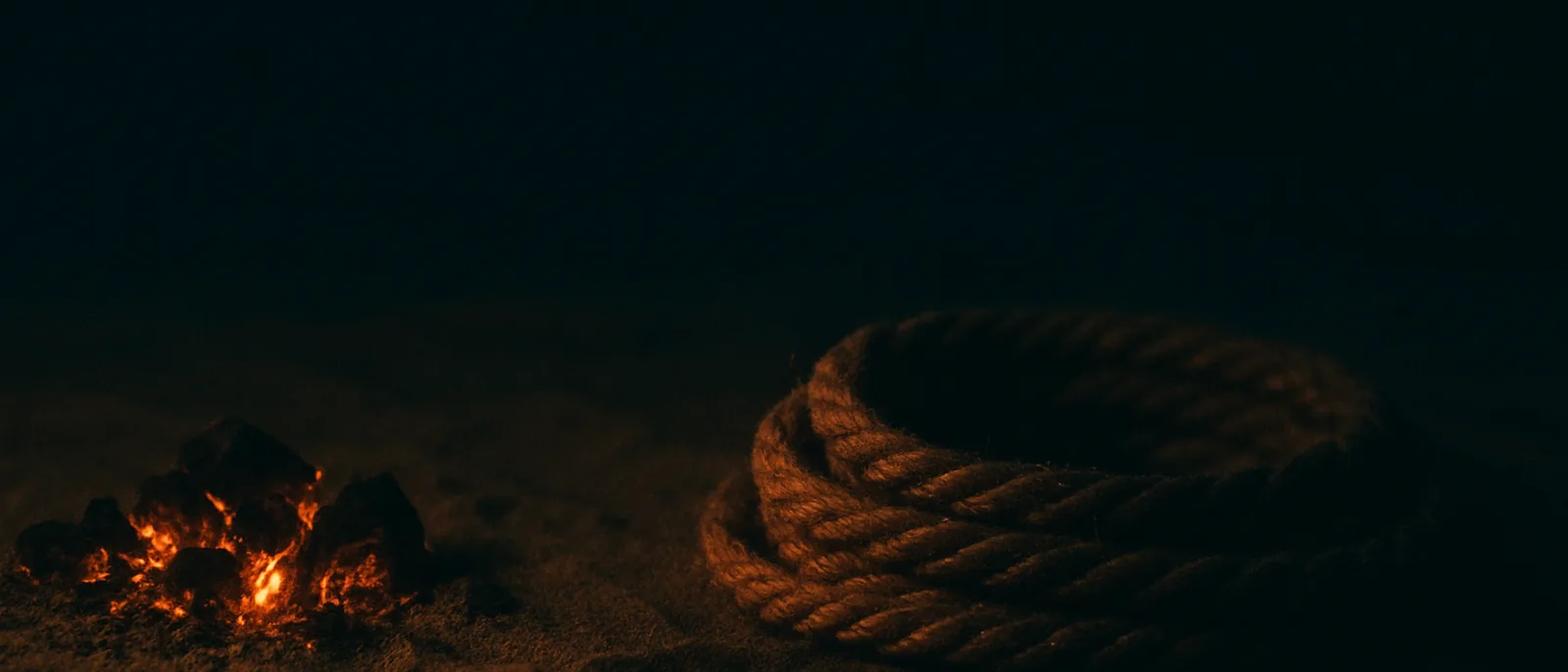
This entry examines Surah al-Masad, which condemned Abu Lahab and his wife to the Fire while both were alive and active opponents of Islam. The argument considered here is that the surah functioned as a standing falsification test for roughly a decade; the counter-reading, that it is an imprecation rather than a prediction, is presented alongside it.
The source text
تَبَّتْ يَدَآ أَبِى لَهَبٍ وَتَبَّ
“May the hands of Abū Lahab be ruined, and ruined is he.”
Qur'an 111:1 · Saheeh International
مَآ أَغْنَىٰ عَنْهُ مَالُهُۥ وَمَا كَسَبَ
“His wealth will not avail him or that which he gained.”
Qur'an 111:2 · Saheeh International
سَيَصْلَىٰ نَارًا ذَاتَ لَهَبٍ
“He will enter to burn in a Fire of blazing flame.”
Qur'an 111:3 · Saheeh International
وَٱمْرَأَتُهُۥ حَمَّالَةَ ٱلْحَطَبِ
“And his wife as well - the carrier of firewood.”
Qur'an 111:4 · Saheeh International
فِى جِيدِهَا حَبْلٌ مِّن مَّسَدٍۭ
“Around her neck is a rope of twisted fiber.”
Qur'an 111:5 · Saheeh International
What was understood in the seventh century
This early Meccan surah is traditionally linked to the Prophet Muhammad's (peace be upon him) public summons of Quraysh at Mount Safa, around 613–614 CE. It names his own uncle, 'Abd al-'Uzza ibn 'Abd al-Muttalib — known by his byname Abu Lahab, "father of flame" — and his wife Umm Jamil bint Harb, declaring both destined for the Fire.
The naming matters for the argument. Both spouses were alive, socially prominent, and among Islam's most energetic opponents when the surah was proclaimed and recited publicly. A short, memorable chapter of the community's own scripture thus committed itself, in advance, to the proposition that two specific living people would die outside the faith. And because the surah entered ordinary recitation, the claim was not filed away in an archive: it was repeated aloud, publicly and continually, within earshot of the very people it named.
The fulfillment record
The fulfillment record is straightforward. Abu Lahab lived roughly a decade after the surah's revelation and died in Mecca about a week after the Battle of Badr, in March 624 CE, reportedly of an ulcerating infection ('adasa), without ever professing Islam. His wife likewise died in opposition. Neither took the step that would have unmade the text, though both lived through years of the community's most public preaching and had every social channel through which to do so.
Apologists since the classical period have drawn out the implication: for some ten years, either spouse could have discredited the Qur'an by simply professing faith — even outwardly and insincerely — since the surah's condemnation was categorical. On this framing, the text accepted a decade-long, publicly checkable risk and was never caught out; a single sentence of profession from either spouse would have been seized upon at once by the Meccan opposition. The correspondence argued here is thus less about the deaths themselves than about the exposure the text tolerated while both subjects lived.
Considerations and counterpoints
Critics reply that the surah is an imprecation — a curse in a recognized ancient genre — not a testable prediction, and that the ostensible test was unfalsifiable in practice: had Abu Lahab professed Islam insincerely, the profession could have been dismissed as hypocrisy (nifaq), a category the Qur'an itself deploys. They add that the probability of an elderly, publicly committed clan enemy converting was negligible, so the risk the text ran was minimal. Defenders respond that Islamic law, following the Qur'an's own precedent, treats outward profession as legally decisive regardless of inner state, so even a feigned conversion would have created a genuine crisis for the text. The entry's force therefore depends on which framing one accepts — a point worth stating plainly, since this item is frequently overclaimed in popular apologetics.
Credibility rating: Tier 2 · Interpretive — Text and outcome are secure, but the item's force as a prophecy depends on accepting the 'falsification test' framing rather than reading the surah as a curse.