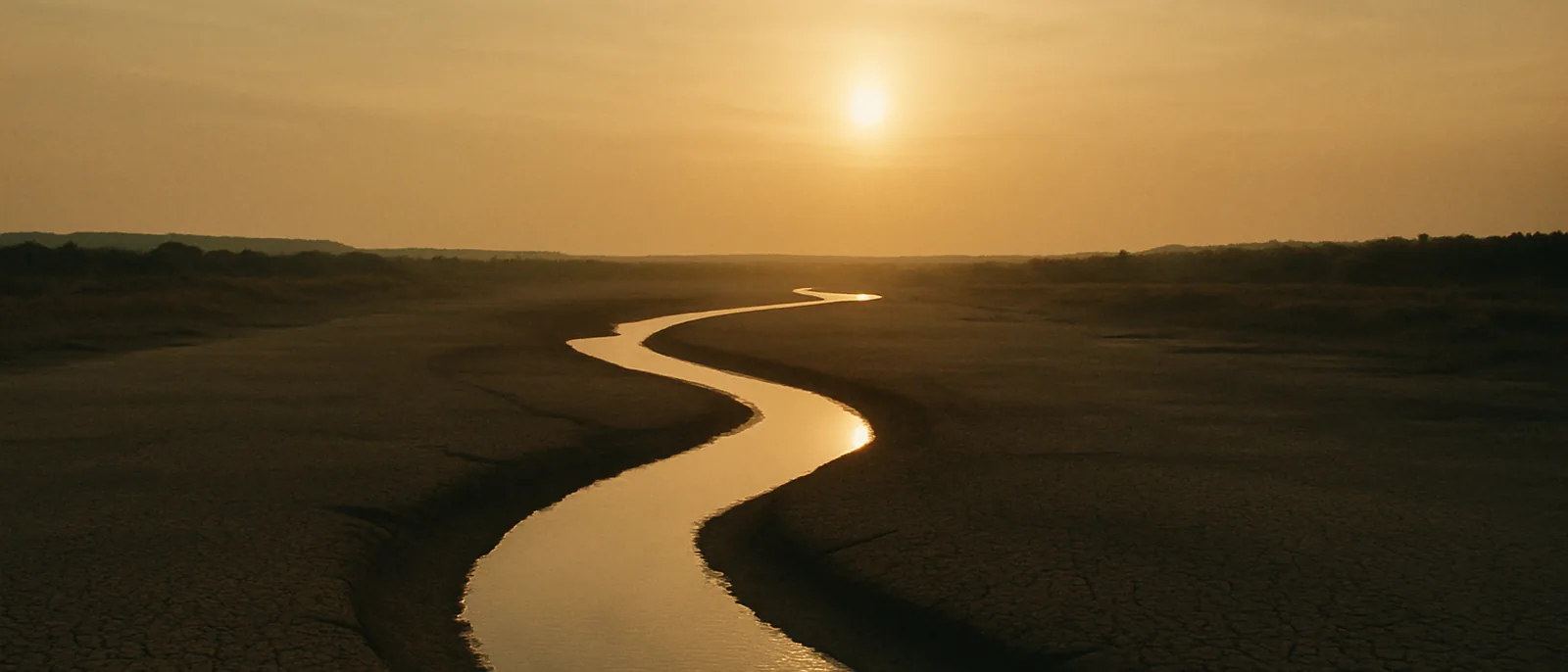
This entry examines the narrations in Sahih al-Bukhari (7119) and Sahih Muslim (2894a) foretelling that the Euphrates will uncover a mountain of gold over which people will fight catastrophically. It is an awaited sign: nothing of the kind has occurred, and the entry is explicit about that from the outset.
The source text
“Soon the river Euphrates will disclose the treasure (the mountain) of gold, so whoever will be present at that time should not take anything of it.”
Sahih al-Bukhari 7119 · Grading: sahih (Bukhari-Muslim by definition)
“The Last Hour would not come before the Euphrates uncovers a mountain of gold, for which people would fight. Ninety-nine out of each one hundred would die but every man amongst them would say that perhaps he would be the one who would be saved (and thus possess this gold).”
Sahih Muslim 2894a · Grading: sahih (Bukhari-Muslim by definition)
What was understood in the seventh century
Both narrations are sahih. The Prophet Muhammad (peace be upon him) states that the Euphrates will soon disclose a treasure — Muslim's wording, a mountain — of gold; that people will fight over it, ninety-nine of every hundred dying, each man believing he will be the one who survives to possess it; and he commands whoever is present to take nothing of it. The command attached to the prophecy is itself unusual, converting the prediction into a standing instruction for whoever witnesses the event.
The Euphrates was the great river of the Sasanian frontier, known to Arab traders and later central to the lands Muslims would govern; its lower valley had carried irrigation, cities, and buried wealth since antiquity. The hadith makes a concrete, falsifiable-in-principle claim about this specific river: that it will recede or open to expose a treasure of gold, with a specified human catastrophe to follow. It thus differs from the more diffuse social signs in this section by naming a place, an object, and an outcome; few eschatological narrations are this exposed to verification.
The fulfillment record
This sign has not been observed. No mountain or treasure of gold has been uncovered by the Euphrates, and the entry must be read as an awaited prediction, not a fulfilled one. That statement is the entry's finding, and everything that follows is context rather than qualification.
As background status only: the river's flow has declined markedly. A NASA study of GRACE satellite data published in 2013 found the Tigris-Euphrates basin lost about 144 cubic kilometers of stored freshwater between 2003 and 2010 — the second-fastest groundwater loss on earth after India (see the NASA JPL release) — and recent droughts have exposed riverbed archaeology in Iraq and Syria.
Popular attempts to read these drought reports as incipient fulfillment, or to treat oil ('black gold') as the hadith's referent, go beyond the text and are declined here: the narration describes literal gold and a specific human catastrophe, and neither has occurred. The site's editorial rule is applied at full strength: an awaited sign earns no credit in advance.
Considerations and counterpoints
Skeptics observe that unfulfilled prophecies carry no evidential weight until they occur, and that the recent drying of the Euphrates is driven by upstream dams and climate change — developments that pattern-seeking readers now retrofit onto the text. They also note that a receding river exposing valuables is an imaginable scenario for any ancient author familiar with rivers and buried wealth. Defenders can fairly reply only that the text remains open; that is true, and it is also the limit of what can be said today. Until the described event occurs, the entry's function is documentary: to fix the wording and its conditions in advance, so that any future claim of fulfillment can be measured against them.
Credibility rating: Tier 2 · Interpretive — Rigorously authentic and unusually specific and testable, but by definition no fulfillment can yet be documented; the tier reflects source strength and specificity, not accomplished correspondence.