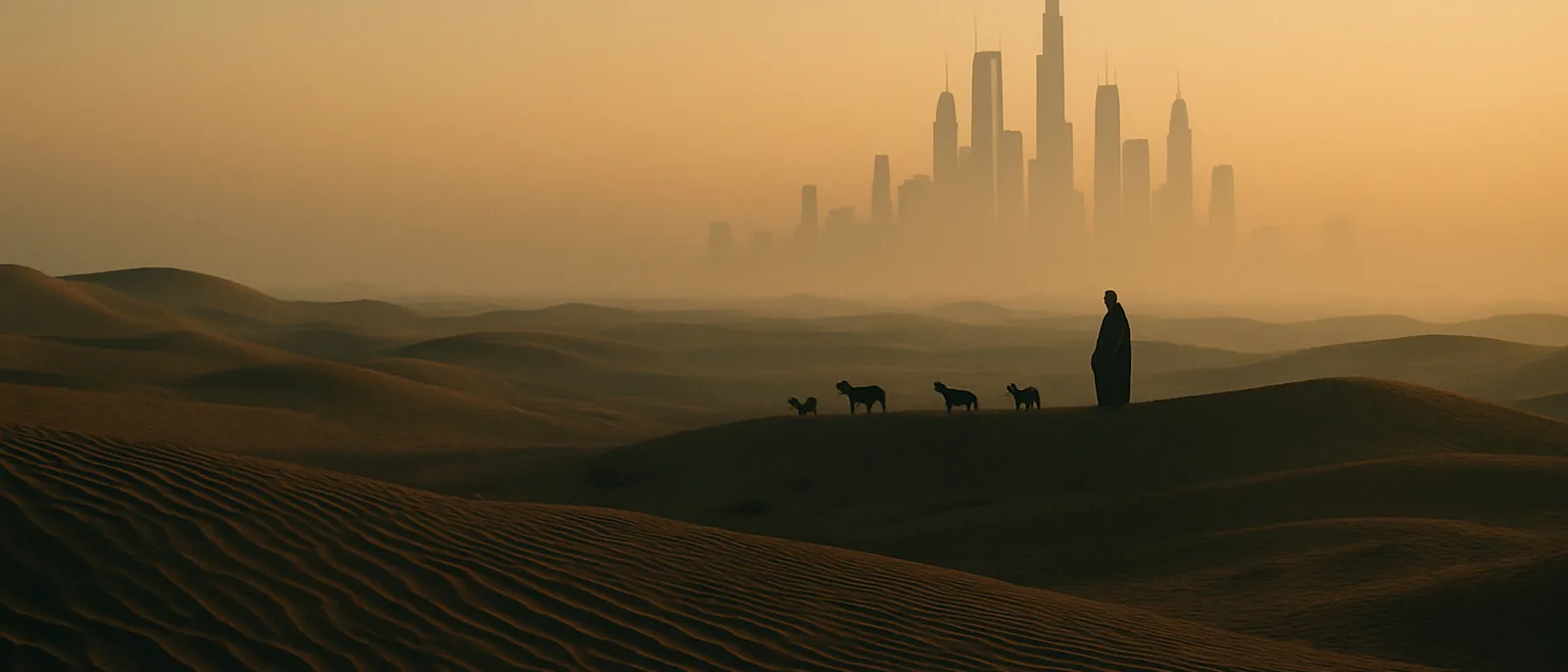
This entry examines a clause of the well-known Jibril hadith, in which the signs of the Hour include the sight of barefoot, destitute herders competing with one another in erecting tall buildings. It sets the seventh-century wording beside the documented construction race of the modern Arabian Gulf, and then presents the standard objections.
The source text
أَنْ تَرَى الْحُفَاةَ الْعُرَاةَ الْعَالَةَ رِعَاءَ الشَّاءِ يَتَطَاوَلُونَ فِي الْبُنْيَانِ
“That the slave-girl will give birth to her mistress and master, that you will find barefooted, destitute goat-herds vying with one another in the construction of magnificent buildings.”
Sahih Muslim 8a · Grading: sahih (Bukhari-Muslim by definition)
“When the shepherds of black camels start boasting and competing with others in the construction of higher buildings.”
Sahih al-Bukhari 50 · Grading: sahih (Bukhari-Muslim by definition)
What was understood in the seventh century
The narration is transmitted in both Sahih Muslim (8a) and Sahih al-Bukhari (50), and is therefore sahih by the most stringent standard the hadith tradition recognizes. It records the Prophet Muhammad (peace be upon him) answering the angel Jibril's question about the signs of the Hour; among the answers is 'that you will find barefooted, destitute goat-herds vying with one another in the construction of magnificent buildings.' Bukhari's version names 'the shepherds of black camels' boasting and competing in higher buildings. The exchange itself is among the most celebrated in the canon — the questioner, later identified as Jibril, asks about faith, worship, and the Hour, and the reply insists that the Hour's exact timing is unknown, offering only signs in its place.
In the seventh-century Hijaz such a scene had no foothold in experience. Buildings were low structures of mudbrick and palm trunk, and monumental construction belonged to the Byzantine and Sasanian empires on the peninsula's periphery, not to Arab pastoralists. The Bedouin herders of sheep and camels were among the poorest and least sedentary people of the region — and it is precisely this destitute herding population that the hadith singles out as future competitors in tall construction.
The fulfillment record
Until the mid-twentieth century the Arabian Gulf littoral remained one of the poorest regions on earth, dependent on pearling, fishing, and herding. The transformation began with oil exports — Saudi Arabia from 1938, Abu Dhabi from 1962, Dubai from 1969 — and within two generations the descendants of that pastoral society were engaged in a construction race without precedent.
Its emblem is the Burj Khalifa in Dubai, completed on 4 January 2010 at 828 meters — recorded by the Council on Tall Buildings and Urban Habitat as the tallest structure ever built — while Saudi Arabia's Jeddah Tower has been designed specifically to exceed it. Gulf cities today account for a disproportionate share of the world's tallest towers, and commentators have noted that the rivalry is explicit: projects are announced with the stated aim of surpassing a neighbor's height. The correspondence argued here is unusually specific, in that the very population the text names — formerly impoverished herders of the Arabian Peninsula — became the builders. The chronology is also compact: a region with essentially no monumental construction at mid-century held the record for the tallest structure ever built within roughly two generations.
Considerations and counterpoints
Skeptics respond that the phrase may be a generic image of social inversion — the lowly becoming ostentatious — rather than a geographic forecast, and that competitive tall building is a worldwide phenomenon not unique to Arabia. Some also note a self-fulfilling element: the Gulf societies erecting these towers are the very societies that revere the hadith, and the narration's open-ended timing means a construction boom in any century could have been claimed as its fulfillment. Readers can weigh these points against the specificity of the population named; the sources for both sides are given in the references below.
Credibility rating: Tier 1 · Strong — A rigorously authenticated text (in both Bukhari and Muslim) with a clear wording whose most natural referent — impoverished Arabian herders competing in tall construction — matches a well-documented 20th-21st-century development.