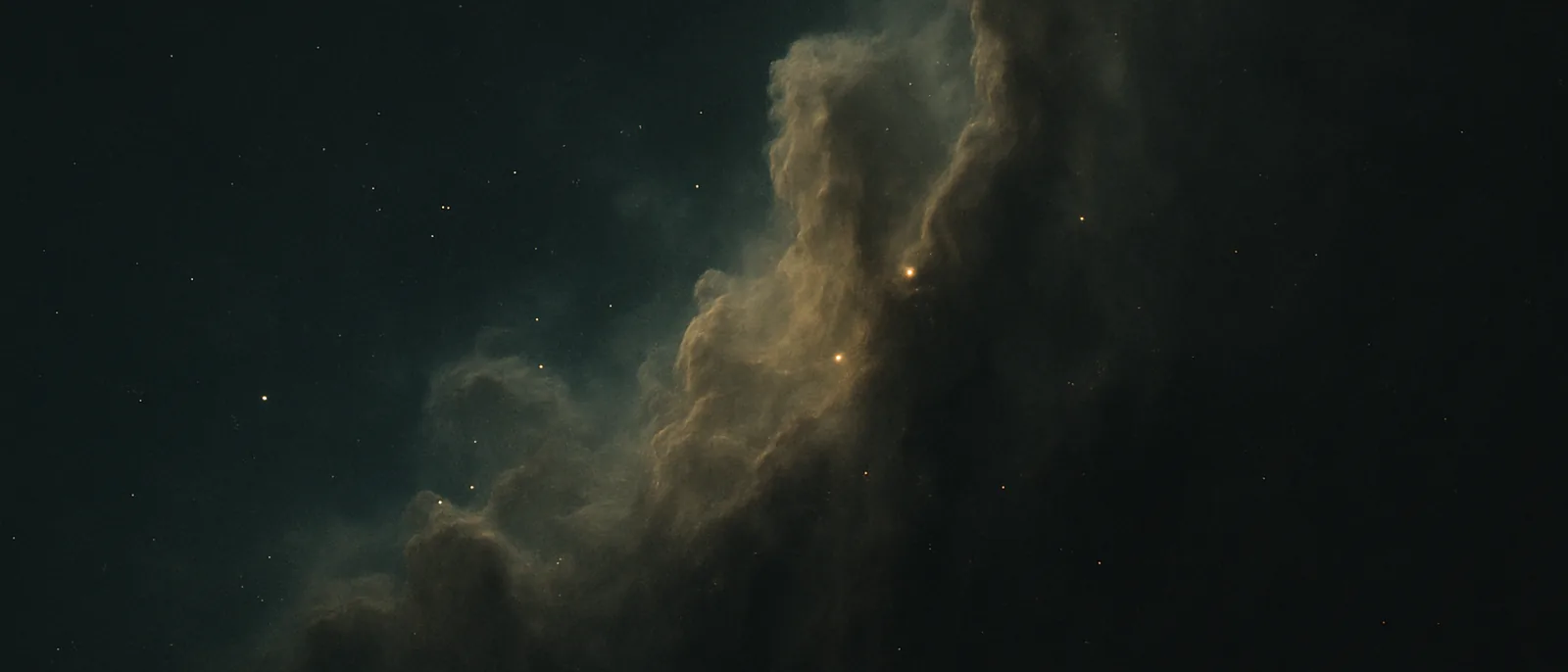
This entry examines Surah Fussilat 41:11, which describes God turning to the heaven “while it was smoke” (dukhan), and the argument that this wording suits the gaseous early universe and the nebular origin of stars and planets.
The source text
ثُمَّ ٱسْتَوَىٰٓ إِلَى ٱلسَّمَآءِ وَهِىَ دُخَانٌ فَقَالَ لَهَا وَلِلْأَرْضِ ٱئْتِيَا طَوْعًا أَوْ كَرْهًا قَالَتَآ أَتَيْنَا طَآئِعِينَ
“Then He directed Himself to the heaven while it was smoke and said to it and to the earth, 'Come [into being], willingly or by compulsion.' They said, 'We have come willingly.'”
Qur'an 41:11 · Saheeh International
What was understood in the seventh century
Seventh-century cosmologies described the sky as a solid vault, a firmament of hammered metal or crystal spheres, or the body of a deity. Genesis places waters above the firmament; Aristotelian physics made the heavens a fifth, unchanging element, the aether. The notion that the heavens had passed through a diffuse, gaseous stage belonged to no Arabian, Biblical, or Greek learned tradition available in the milieu of the Prophet Muhammad (peace be upon him).
A hot, opaque, gas-like early sky therefore had no obvious precedent in the region's traditions — which is what gives the single word dukhan its interest here. In everyday Arabic the word meant the smoke of a fire — hot, dark, particulate, and without fixed form — and it is precisely that ordinariness that modern readers press: the verse reaches for the nearest lay word for a diffuse, heated medium.
The modern correspondence
Modern astrophysics holds that the early universe was filled with a hot, opaque plasma and later with diffuse gas, mostly hydrogen and helium, and that stars and planetary systems condense from clouds of interstellar gas and dust — nebulae — with the solar system forming from such a cloud about 4.6 billion years ago. This picture was assembled between the nineteenth and twentieth centuries: the nebular hypothesis was refined from Laplace's work of 1796 onward, and the hot early universe was confirmed observationally in 1965.
On the nebular account, the sun and planets condensed together from a single collapsing cloud, so the material that became the earth and the material that became the sky share a gaseous ancestry — a point proponents pair with the 'joined entity' of the previous entry in this section.
Commentators have argued that “smoke” — a hot, particulate, gaseous mixture — is an apt lay description of both the early universe and the solar nebula, and that a seventh-century audience possessed no better everyday word for such a state. The references below include standard descriptions of nebulae and of the early universe.
Considerations and counterpoints
The strongest objection concerns sequence rather than vocabulary. The surrounding passage, 41:9–12, appears to describe the earth being created and furnished before God turned to the heaven “while it was smoke,” which inverts the astrophysical order in which stars, including the sun, long precede the earth; both apologetic and skeptical literature treat this creation-order question as central, and any fair reading must address it. Classical commentators variously said the smoke arose from a primordial water — a mythic rather than nebular image — and critics add that smoke rising to form the sky is attested in earlier Near Eastern and rabbinic imagery. Calling a hot plasma “smoke,” they conclude, is a loose analogy that looks precise only in hindsight. Defenders commonly reply that the passage's conjunctions need not be strictly chronological in Arabic narration; critics find that reading strained in a passage that counts creative days. The creation-order question remains the decisive one for this item, and readers should weigh it directly against the passage in full.
Credibility rating: Tier 2 · Interpretive — The smoke/gas parallel is suggestive and often cited, but it depends on selecting one verse from a creation sequence whose overall order is contested.