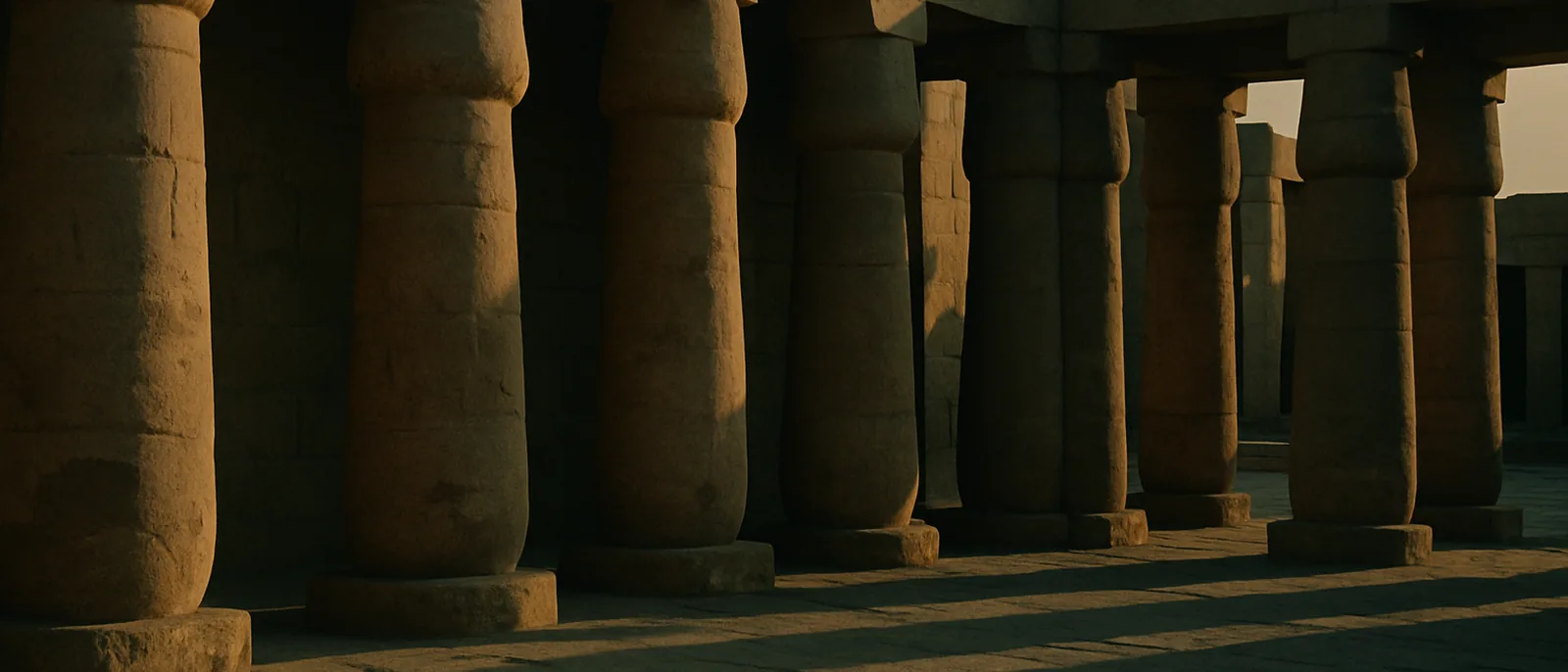
This entry examines a pattern of royal titles in the Qur'an: the Egyptian ruler of Joseph's story is called 'the king' (al-malik) and never 'Pharaoh,' while the ruler of Moses' story is called Fir'awn throughout and never 'king.' Egyptology later established that 'pharaoh' came into use as a title for the king's person only centuries after the era in which Joseph is traditionally placed.
The source text
وَقَالَ ٱلْمَلِكُ ٱئْتُونِى بِهِۦٓ أَسْتَخْلِصْهُ لِنَفْسِى ۖ فَلَمَّا كَلَّمَهُۥ قَالَ إِنَّكَ ٱلْيَوْمَ لَدَيْنَا مَكِينٌ أَمِينٌ
“And the king said, "Bring him to me; I will appoint him exclusively for myself." And when he spoke to him, he said, "Indeed, you are today established [in position] and trusted."”
Qur'an 12:54 · Saheeh International
وَقَالَ فِرْعَوْنُ ذَرُونِىٓ أَقْتُلْ مُوسَىٰ وَلْيَدْعُ رَبَّهُۥٓ ۖ إِنِّىٓ أَخَافُ أَن يُبَدِّلَ دِينَكُمْ أَوْ أَن يُظْهِرَ فِى ٱلْأَرْضِ ٱلْفَسَادَ
“And Pharaoh said, "Let me kill Moses and let him call upon his Lord. Indeed, I fear that he will change your religion or that he will cause corruption in the land."”
Qur'an 40:26 · Saheeh International
What was understood in the seventh century
The Book of Genesis, as read in the seventh century and today, calls the Egyptian ruler of Joseph's time 'Pharaoh' throughout (for example Genesis 41), just as Exodus does for Moses' antagonist. Anyone retelling the biblical stories from that source would naturally have used 'Pharaoh' in both settings; the word functioned simply as the name for any king of Egypt, and Jewish and Christian retellings known to Arabia followed the same habit.
Nothing available in seventh-century Arabia distinguished the royal titulary of one Egyptian period from another. Hieroglyphic writing had been unreadable for centuries and would remain so until Champollion's decipherment in 1822; the chronology of Egyptian titles was not merely unknown but unknowable, in Arabia or anywhere else, since the only key to it lay in a script no living person could read.
The modern correspondence
Egyptology established in the nineteenth and twentieth centuries that 'pharaoh' derives from per-aa, 'Great House' — a term that originally denoted the palace and only came to be used of the king's person from the New Kingdom onward, conventionally from the reign of Thutmose III or slightly later (mid-fifteenth century BCE), with clear vocative use by the time of Akhenaten. Joseph's story, when historicized at all, is customarily placed in the Middle Kingdom or Hyksos period, centuries before that shift, while Moses is placed squarely in the New Kingdom.
Commentators have noted that the Qur'an matches this pattern with complete consistency. In Surah Yusuf the ruler is called al-malik, 'the king' (12:43, 12:50, 12:54, 12:72, 12:76), and the word 'Pharaoh' never appears; in the Moses narratives the ruler is called Fir'awn scores of times and never 'king.'
The comparison that sharpens this point is with the Bible, the very source the Qur'an is alleged to have drawn upon. The Book of Genesis calls the ruler of Joseph's era 'Pharaoh' repeatedly — indeed 'Pharaoh king of Egypt' at Genesis 41:46 — and the Book of Exodus uses the same title for Moses' antagonist, so the biblical narrative applies 'Pharaoh' to both periods alike. The Qur'an does not: it withholds the title from Joseph's ruler and reserves it for Moses'. Where the earlier text uses one word across both eras, the Qur'an draws precisely the distinction that the later decipherment of Egyptian would vindicate. The pattern is verifiable by any reader against both texts, and it runs against, rather than with, the source the Qur'an is said to have copied.
Considerations and counterpoints
Two honest qualifications should temper the argument. First, the Bible is not uniform in its own usage: alongside 'Pharaoh' it also calls the Egyptian ruler 'the king of Egypt' in both the Joseph and the Moses narratives, so the contrast is not that Genesis knows only 'Pharaoh' while the Qur'an knows 'king,' but the narrower point that Genesis applies the title 'Pharaoh' to Joseph's ruler where the Qur'an never does. Second, and more fundamentally, since neither Joseph nor Moses can be located historically — many historians regard both narratives as legendary — there is no fixed date against which the Qur'an's usage can be called 'correct.'
The variation could therefore be stylistic, or could reflect the fact that Fir'awn functions in the Qur'an as the proper name of one specific tyrant rather than as a general title for Egyptian kings. Some also note that if Joseph served a Hyksos ruler, calling him 'king' is unremarkable, and that an incidental divergence from Genesis, however fortunate, does not by itself require special knowledge. The Tier 2 grading reflects that the textual pattern is real and verifiable while the argument presupposes traditional datings that mainstream scholarship treats as unestablished.
Credibility rating: Tier 2 · Interpretive — The textual pattern is real, verifiable, and runs against the Qur'an's alleged biblical source, but the argument presupposes traditional datings of Joseph and Moses that mainstream scholarship treats as unestablished.