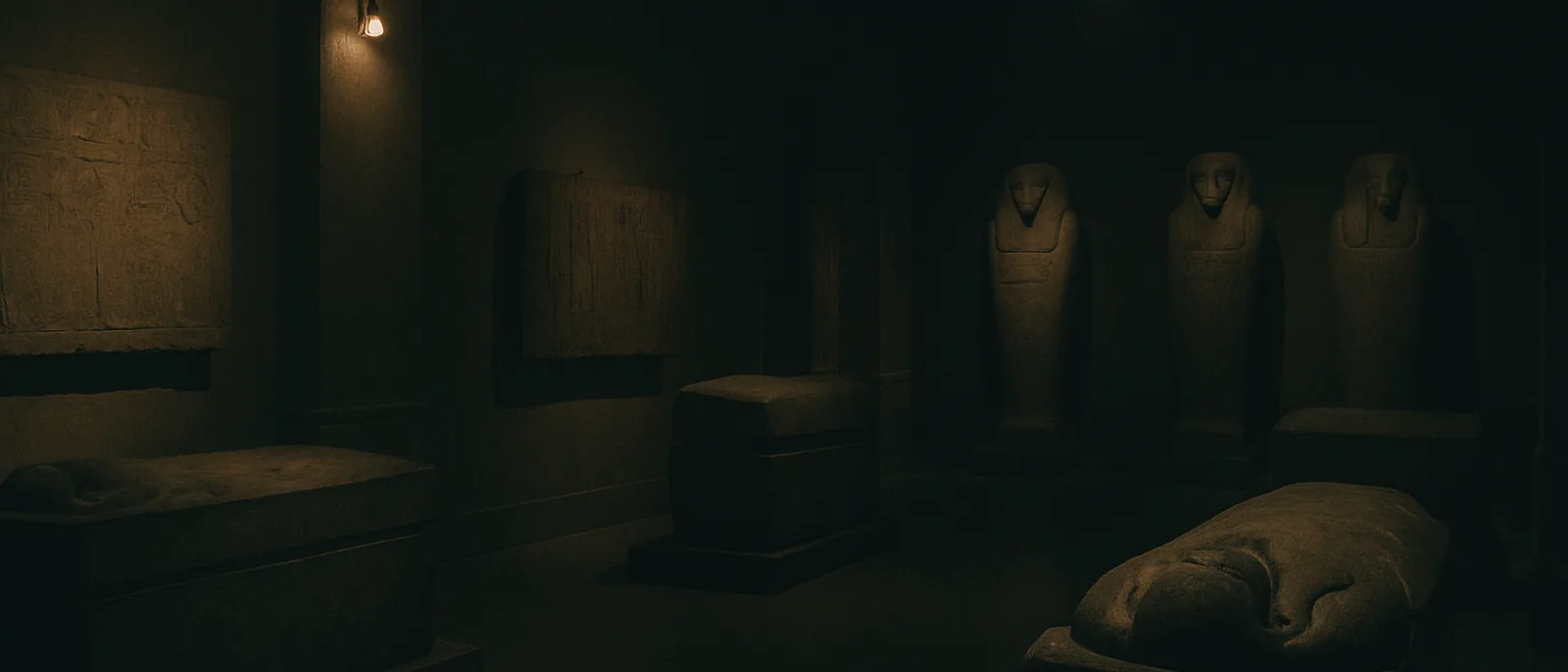
This entry examines the declaration of Surah Yunus that the drowning ruler who pursued the Children of Israel would be saved 'in body' to serve as a sign for later generations. It sets that statement beside the modern recovery and public display of Egypt's royal mummies, and weighs how far the two can fairly be connected.
The source text
فَٱلْيَوْمَ نُنَجِّيكَ بِبَدَنِكَ لِتَكُونَ لِمَنْ خَلْفَكَ ءَايَةً ۚ وَإِنَّ كَثِيرًا مِّنَ ٱلنَّاسِ عَنْ ءَايَـٰتِنَا لَغَـٰفِلُونَ
“So today We will save you in body that you may be to those who succeed you a sign. And indeed, many among the people, of Our signs, are heedless.”
Qur'an 10:92 · Saheeh International
وَجَـٰوَزْنَا بِبَنِىٓ إِسْرَٰٓءِيلَ ٱلْبَحْرَ فَأَتْبَعَهُمْ فِرْعَوْنُ وَجُنُودُهُۥ بَغْيًا وَعَدْوًا ۖ حَتَّىٰٓ إِذَآ أَدْرَكَهُ ٱلْغَرَقُ قَالَ ءَامَنتُ أَنَّهُۥ لَآ إِلَـٰهَ إِلَّا ٱلَّذِىٓ ءَامَنَتْ بِهِۦ بَنُوٓا۟ إِسْرَٰٓءِيلَ وَأَنَا۠ مِنَ ٱلْمُسْلِمِينَ
“And We took the Children of Israel across the sea, and Pharaoh and his soldiers pursued them in tyranny and enmity until, when drowning overtook him, he said, "I believe that there is no deity except that in whom the Children of Israel believe, and I am of the Muslims."”
Qur'an 10:90 · Saheeh International
What was understood in the seventh century
In the seventh century, the story of the sea crossing reached Arabia chiefly through Jewish and Christian oral tradition. The biblical account in Exodus 14 ends with the Egyptian army destroyed in the water; it says nothing of the ruler's corpse being recovered, let alone preserved for posterity. A listener in Mecca or Medina knew no version of the story in which the king's body outlived the catastrophe as an object lesson for later nations.
Nor could observation supply such an idea. The royal mummies of New Kingdom Egypt lay hidden in caches at Deir el-Bahari and in the Valley of the Kings, concealed by ancient priests and unknown to anyone in late antiquity; they would remain undiscovered for roughly another twelve centuries. When the ayah stated that the drowning ruler's body would remain 'a sign' to those who came after, the statement had no observable referent anywhere in the known world.
The modern correspondence
In 1881 the cache at Deir el-Bahari (tomb TT320) yielded dozens of royal mummies, among them Ramesses II, and in 1898 Victor Loret opened a second cache in tomb KV35 containing Merneptah — the two kings most often proposed as the pharaoh of the Exodus. The physical bodies of the New Kingdom pharaohs thus genuinely survive. In April 2021 twenty-two of them, Ramesses II and Merneptah included, were carried through Cairo in the televised 'Pharaohs' Golden Parade' to the National Museum of Egyptian Civilization, where millions have since viewed them (see the references below).
Commentators have noted the resonance: the body of a pharaoh of the relevant era does remain, quite literally, a sign visible to later generations. Two qualifications must be stated plainly. Egyptology cannot identify which pharaoh, if any, corresponds to the Qur'anic figure, and mainstream archaeology finds no direct evidence for the Exodus event itself. The popular claims of Maurice Bucaille — that salt traces in Ramesses II's mummy prove death by drowning — are not accepted in the Egyptological literature, and this entry does not rely on them.
Considerations and counterpoints
Skeptics observe that Egyptian mummification was famous throughout antiquity, so a seventh-century author could reasonably expect an Egyptian king's body to endure somewhere. Classical commentators such as al-Tabari read the verse not as a prediction of museum display but as the corpse being cast ashore so the Israelites could see their oppressor dead that very day — a reading that requires no modern fulfillment at all. Critics add that the survival of Ramesses II's or Merneptah's mummy results from routine royal embalming rather than from any drowning, that no evidence ties either king to a sea disaster, and that since the Exodus narrative itself lacks archaeological corroboration, the correspondence presupposes events that remain unverified. The connection argued here is therefore interpretation-dependent, as the Tier 2 grading reflects.
Credibility rating: Tier 2 · Interpretive — Authentic text and a real, striking correspondence (royal bodies do survive as public 'signs'), but the specific pharaoh cannot be identified and the Exodus itself lacks archaeological corroboration, so the link is interpretation-dependent.