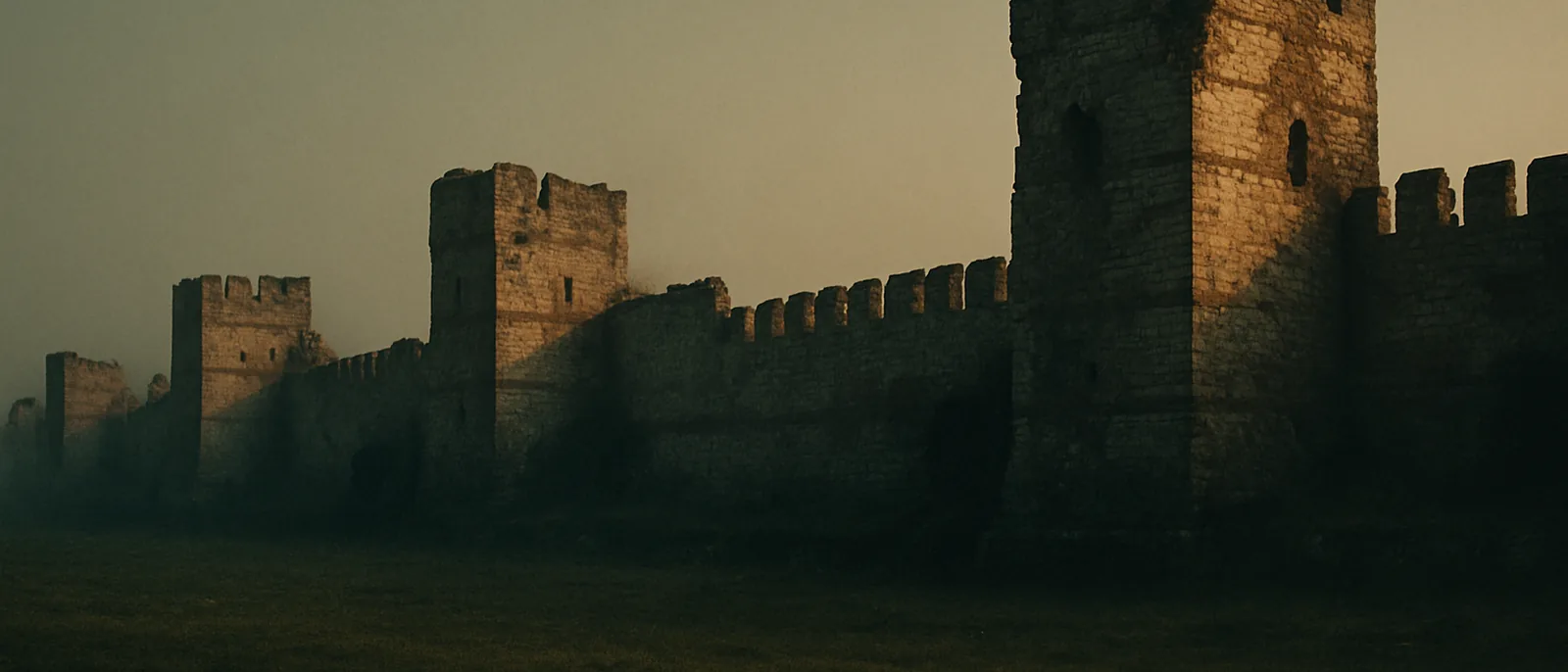
This entry examines the reported saying "Verily you shall conquer Constantinople" alongside the authenticated Bukhari narration about the first army to campaign against "Caesar's city." The fulfillment of 1453 is undisputed history; the authentication of the specific Constantinople hadith is genuinely contested, and both facts shape how the entry is weighed.
The source text
لَتُفْتَحَنَّ الْقُسْطَنْطِينِيَّةُ فَلَنِعْمَ الأَمِيرُ أَمِيرُهَا وَلَنِعْمَ الْجَيْشُ ذَلِكَ الْجَيْشُ
“Verily you shall conquer Constantinople. What a wonderful commander will its commander be, and what a wonderful army will that army be!”
Musnad Ahmad 18957 (al-Risala edition numbering) · Grading: disputed (al-Hakim graded it sahih with al-Dhahabi concurring; several later and contemporary specialists grade the isnad da'if)
“From the hadith of Umm Haram: 'The first army amongst my followers who will invade Caesar's city will be forgiven their sins.'”
Sahih al-Bukhari 2924 · Grading: sahih (Bukhari-Muslim by definition)
What was understood in the seventh century
In the 620s Constantinople was the most heavily fortified city in the world. In 626 it had just repelled a combined Avar–Persian siege; its walls would remain unbreached by any attacker for another six centuries. The Arabs of the Hijaz, by contrast, possessed no navy, no siege train, and no state. An announcement in that setting that Muslims would one day take the city had no contemporary basis whatever.
Two texts anchor the claim. The famous wording — "What a wonderful commander will its commander be, and what a wonderful army will that army be" — appears in Musnad Ahmad, a collection compiled in the ninth century, and its grading is disputed: al-Hakim declared it sahih with al-Dhahabi concurring, while other specialists, classical and contemporary, grade its chain da'if. Separately, Sahih al-Bukhari 2924 records the Prophet Muhammad (peace be upon him) saying that the first of his followers' armies to campaign against Caesar's city would be forgiven — a rigorously authenticated text that presupposes such a campaign would happen.
The fulfillment record
The fulfillment record spans eight centuries. Muslim armies besieged Constantinople unsuccessfully in 674–678 and 717–718 CE; the expedition of 669, joined by the aged companion Abu Ayyub al-Ansari, is commonly identified with the "first army" of Bukhari 2924. Abu Ayyub died beneath the walls, and his tomb there became a fixture of the later city — a measure of how seriously the early community took the promise attached to that campaign.
The city finally fell to the Ottoman sultan Mehmed II on 29 May 1453 — among the most thoroughly documented events of the fifteenth century, as the references below attest. Ottoman tradition explicitly invoked the Musnad Ahmad hadith, styling Mehmed the "wonderful commander" of the prophecy. On the predictive reading, the statement stood open for more than eight hundred years, through repeated failures, before an army bearing it as a motto carried the walls.
Considerations and counterpoints
The objections are substantial. The grading dispute is real: critics of the Musnad Ahmad chain consider a narrator insufficiently established, and the report surfaces in a collection compiled about two centuries after the statement. Skeptics further note that the hadith functioned for eight hundred years as a standing military aspiration for Muslim rulers, making its eventual fulfillment partly self-fulfilling — an army that sets out to fulfill a prophecy is not independent evidence of it. Some Muslim scholars themselves read the promised conquest as a still-future eschatological event rather than 1453. Defenders reply that the authenticated Bukhari narration independently foresaw campaigns against Caesar's city when no such thing was conceivable, and that self-fulfillment cannot manufacture the capability to breach the strongest fortifications in the world. The entry is tiered below the top rank for these reasons.
Credibility rating: Tier 2 · Interpretive — The fulfillment is spectacular and undisputed history, but the specific Constantinople hadith's authentication is genuinely contested, so the item cannot honestly sit in tier 1.