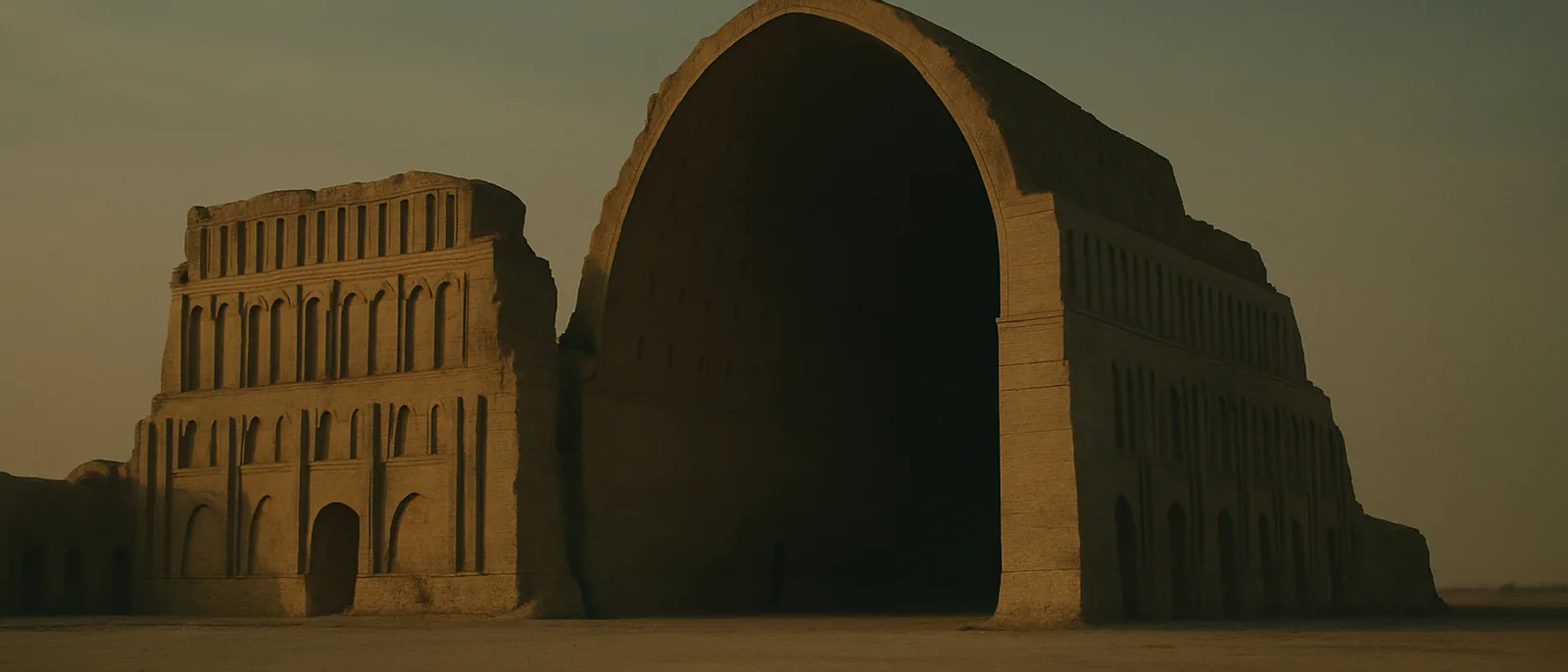
This entry examines the hadith, recorded through multiple chains in Sahih al-Bukhari and Sahih Muslim, that when the reigning Khosrow perished there would be no Khosrow after him, that the same would hold of Caesar, and that Muslims would spend the treasures of both in God's cause. It traces the fates of the two imperial lines and the classical reading of the asymmetry between them.
The source text
إِذَا هَلَكَ كِسْرَى فَلاَ كِسْرَى بَعْدَهُ، وَإِذَا هَلَكَ قَيْصَرُ فَلاَ قَيْصَرَ بَعْدَهُ، وَالَّذِي نَفْسِي بِيَدِهِ لَتُنْفَقَنَّ كُنُوزُهُمَا فِي سَبِيلِ اللَّهِ
“When Khosrau is ruined, there will be no Khosrau after him; and when Caesar is ruined, there will be no Caesar after him. By Him in Whose Hands my life is, you will spend their treasures in Allah's Cause.”
Sahih al-Bukhari 3120 · Grading: sahih (Bukhari-Muslim by definition)
“When Khosrau perishes, there will be no more Khosrau after him, and when Caesar perishes, there will be no more Caesar after him. By Him in Whose Hands Muhammad's life is, you will spend the treasures of both of them in Allah's Cause.”
Sahih al-Bukhari 3618 · Grading: sahih (Bukhari-Muslim by definition)
“Kisra (Khusrau, king of Persia) would die, and there would be no Kisra after him, and Qaisar (Caesar, king of Rome) would die and there would be no Qaisar after him, but, by the One in Whose Hand is my life, you would spend their treasures in the cause of Allah.”
Sahih Muslim 2918a · Grading: sahih (Bukhari-Muslim by definition)
إِذَا هَلَكَ كِسْرَى فَلاَ كِسْرَى بَعْدَهُ
“When Kisra would die there would be no Kisra after him (narrated by Jabir b. Samura; the rest of the hadith is the same as Abu Huraira's report).”
Sahih Muslim 2919a · Grading: sahih (Bukhari-Muslim by definition)
What was understood in the seventh century
In the 620s CE, Sasanian Persia and Byzantium were the two superpowers flanking Arabia, each maintaining Arab client kingdoms as buffers against the desert. Arabia itself was a stateless periphery with no army, treasury, or administration of its own. The hadith — transmitted from the Prophet Muhammad (peace be upon him) through independent sahih chains, including Bukhari 3120 and 3618 and Muslim 2918–2919 — asserted that the Persian royal title would end permanently, that the Caesars would likewise be "ruined," and that the desert Arabs would disburse the hoarded wealth of both empires.
To any contemporary, each clause would have sounded fantastical. The two empires had flanked Arabia for centuries; the notion that either throne, let alone both treasuries, lay within the reach of the Hijaz had no basis in the balance of power as it stood. The saying also binds two distinct claims together — dynastic extinction and the disposal of treasure — so that a partial coincidence would not have satisfied it.
The fulfillment record
The Persian clause was fulfilled with finality. Khosrow II was deposed and killed by his own son in February 628 CE, triggering a decade of coups and short reigns. Yazdegerd III, the last Sasanian king, was murdered near Merv in 651, and no "Kisra" ever reigned over Persia again — the line was extinguished, not merely defeated, as the references below record.
The Byzantine clause unfolded differently: the emperors survived in Constantinople, but within a decade of the Prophet's death they permanently lost Syria, Palestine, and Egypt to the Muslim conquests. The treasury of Ctesiphon, captured in 637, and the wealth of the former Byzantine provinces were distributed through the Muslim public treasury under the caliph 'Umar — the "spending of their treasures" taken literally. Classical commentators such as al-Nawawi and Ibn Hajar read the hadith precisely along these lines: no Kisra over Persia thereafter, and no Caesar over Syria and the East thereafter — which is what occurred.
Considerations and counterpoints
Two objections carry weight. First, the collections recording the hadith were compiled in the ninth century, some two centuries after the events, so critics argue that a prophecy-after-the-fact (vaticinium ex eventu) cannot be excluded on documentary grounds alone. Second, the apparent asymmetry: Caesars in fact continued in Constantinople until 1453, so the fulfillment requires the qualifying interpretation — "no Caesar over Syria and the East" — rather than the plainest reading of the words. Defenders reply that this qualified reading is exactly what the earliest commentators gave, without embarrassment, and that the two clauses were fulfilled asymmetrically in precisely the way the interpretation describes: the Persian line annihilated, the Byzantine line expelled from the lands nearest Arabia. Readers must judge whether that pattern reads as precision or as accommodation.
Credibility rating: Tier 1 · Strong — Multiple independent sahih chains in Bukhari and Muslim, with a fulfillment (the permanent extinction of the Sasanian line and Muslim expenditure of both empires' treasure) that is central, dated world history.